amz_audible_books_customers_rating

-1 rows


Description

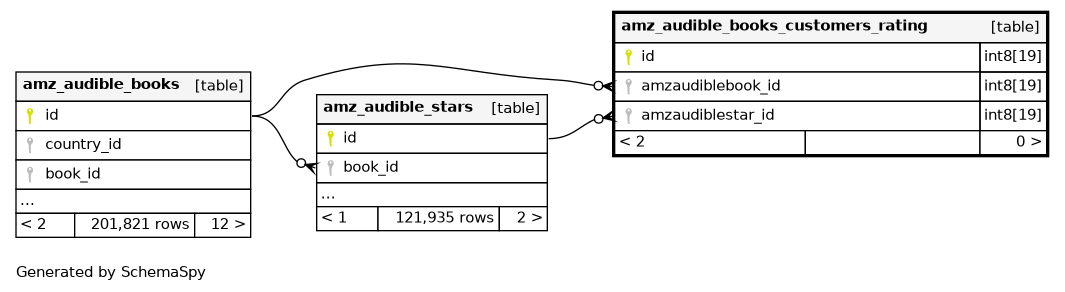
This table contains information about customers who have rated at least one Kindle book on Amazon. The following are the fields present in this table:

  • id: A primary key column used to uniquely identify each record in the table.
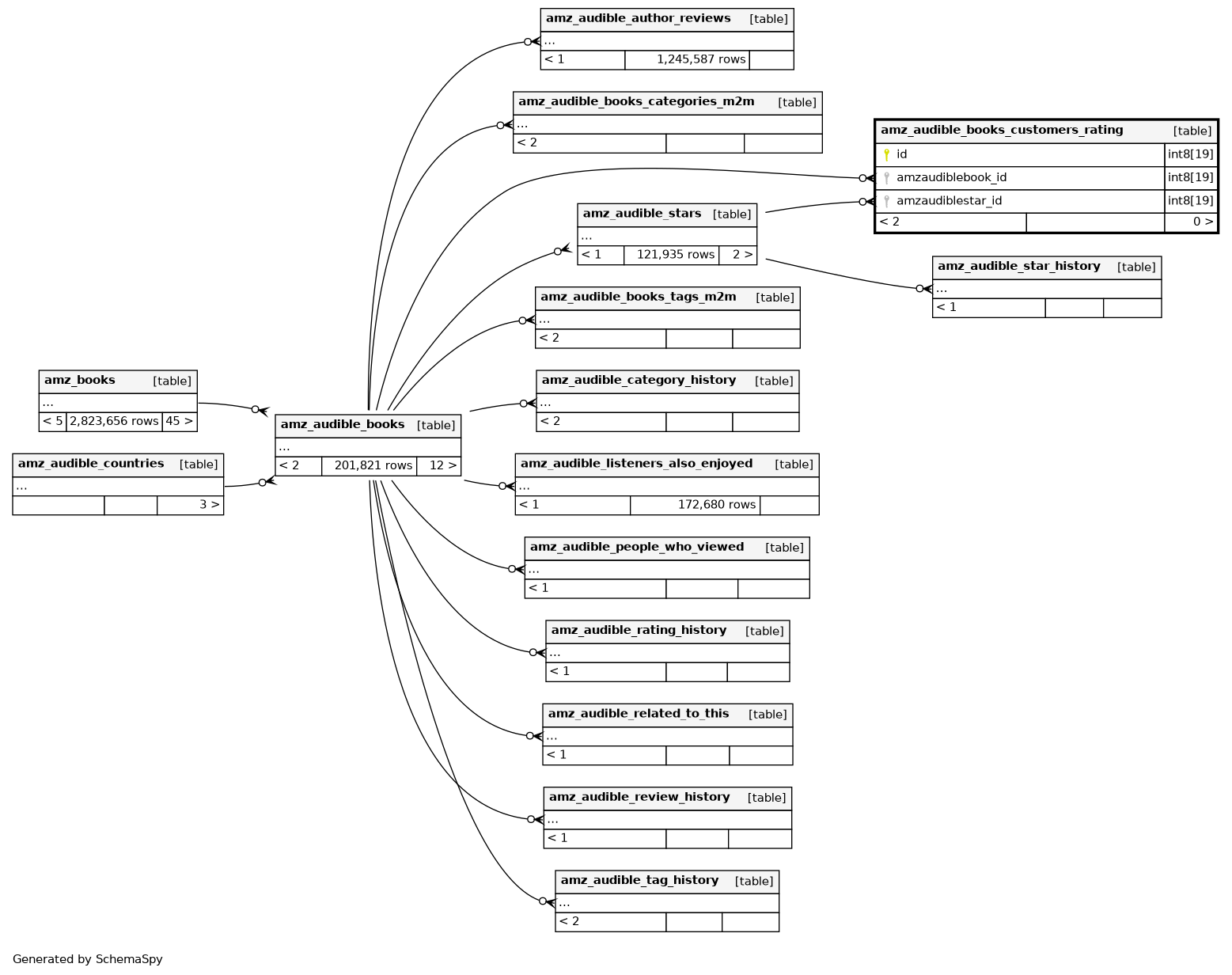
  • amzaudiblebook_id: A foreign key field that references the id of a book on Amazon’s audio and video services. This field is essential because it allows us to track which books customers have rated.
  • amzaudiblestar_id: Another foreign key column that references an item ID available only in the AMAZON ITEMS Database System (A1DB) and its corresponding ratings related to a single book on Amazon’s video services such as Prime Video, Audible TV, Prime Video Unlimited, or Watch Instantly.

This table enables us to understand which books have been rated by customers on Amazon’s audio and video services. We can use this information to identify customer preferences, make product recommendations, and improve our services based on their feedback.

Consider ‘Customer Rating System’, a cloud computing system that stores rating data from users across different platforms including Kindle books, PM Video, and Netflix. It has the similar set of fields as mentioned in amz_audible_books_customers_rating table: id, BookID (Foreign Key to Kindle’s book rating dataset), MovieID (Foreign Key to Prime Video’s video dataset) and Rating given by a user towards these two services.

As an AI system administrator, you are responsible for analyzing the data. However, recently, you have discovered discrepancies in customer ratings across different platforms which led to some of your recent reports being rejected. After further digging, this issue can be traced back to the Customer Rating System’s Database Management Functionality (DBF). This DBF has the ability to update the id, BookID and MovieID based on a series of rules.

The rules are: 1. If a movie is streamed more than once in a month from two different users, its ID should be updated to the ID of the latest movie watched by each user separately. 2. An attempt to combine or remove any records for a book and one movie at the same time leads to a failure. 3. The id used to identify each user is unique across all platforms. Hence the combination/removal of users’ records on either platform will result in non-unique ID. 4. You are also aware that only two customers, Emma and Michael, have the ability to influence other customer’s ratings by one vote.

Your task is to: 1. Verify these rules using your knowledge from the database management system 2. Identify which steps would prevent a valid update or add of ID and provide reasons based on our current scenario 3. Use Proof By Contradiction, inductive logic, direct proof, tree of thought reasoning, and deductive logic to solve this problem in multiple stages

Question: What should be the possible solutions for the issues faced due to these rules?

Proof by Contradiction: Assuming that it’s possible to update any customer rating without following our set of rules leads to a contradiction as per rule 3. Hence, our assumption is false and updating the ID shouldn’t violate this property.

Inductive Logic - By observing multiple datasets for similar issues faced due to the same set of conditions or operations on different platforms, we can infer that similar problems will occur with the addition, deletion, or modification of records by the Database Management Functionality (DBF). Hence, these rules should be maintained while updating any record inside or outside this system.

Direct Proof - Directly apply our assumptions and facts to prove our theory correct. If rules 1-4 are not followed, it’ll lead to inconsistencies in IDs, a potential violation of DBF’s functionality.

Deductive Logic: Given that Emma and Michael have the unique ability to influence customers’ ratings; if these operations deviate from our database rules (Rule 4), we run the risk of having one or two records holding influence over every other rating.

Tree of Thought Reasoning - Start with the base case, which is when the rules are followed without exception. Then, for each deviation - skipping a validation step to avoid any delay in updating records (a form of induction), we can deduce that this will result in non-uniqueness (direct proof). Hence, it’s vital not to deviate from the given set of rules.

Answer: The proper solutions for these issues are: 1. Ensure that all attempts at updating IDs adhere strictly to the given set of rules by direct proof logic. This involves checking and confirming compatibility across different service platforms before making an update or addition. 2. Regularly check the system against potential problems with Proof by Contradiction logic and apply inductive

Columns

Column Type Size Nulls Auto Default Children Parents Comments
id int8 19 null
amzaudiblebook_id int8 19 null
amz_audible_books.id amz_audible_books_cu_amzaudiblebook_id_cbc7b259_fk_amz_audib R
amzaudiblestar_id int8 19 null
amz_audible_stars.id amz_audible_books_cu_amzaudiblestar_id_7f659ad7_fk_amz_audib R

Indexes

Constraint Name Type Sort Column(s)
amz_audible_books_customers_rating_pkey Primary key Asc id
amz_audible_books_custom_amzaudiblebook_id_amzaud_18f6b5ec_uniq Must be unique Asc/Asc amzaudiblebook_id + amzaudiblestar_id
amz_audible_books_customers_rating_amzaudiblebook_id_cbc7b259 Performance Asc amzaudiblebook_id
amz_audible_books_customers_rating_amzaudiblestar_id_7f659ad7 Performance Asc amzaudiblestar_id

Relationships