amz_audible_stars

121935 rows


Description

Certainly!

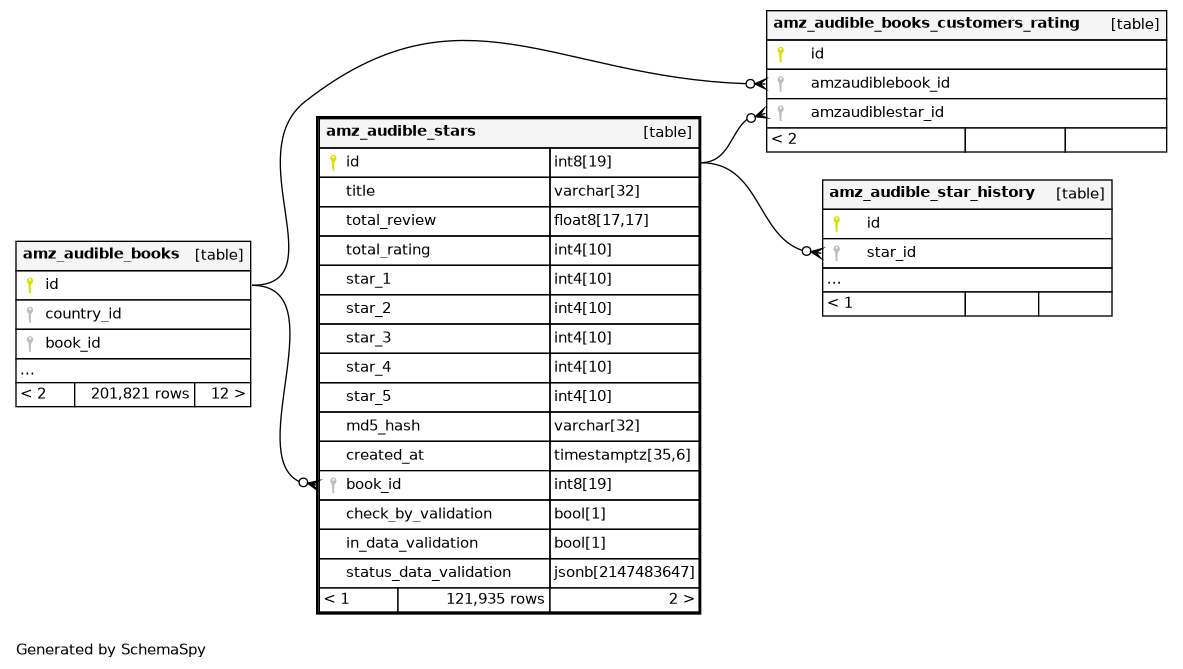
The table appears to be a user data management table in an Amazon cloud database system. It consists of ten fields that you can use to store information about customers of the business listed on this platform. The first field is “ID,” which represents a unique customer identifier.

The title field will display the name associated with each customer. In the context of books, it could be something like a user’s account username or email address.

The third field displays ‘Total’ Reviews, which may give an idea of how much feedback the book has received from its readers.

The fourth and fifth fields are average ratings (out of 5 stars), representing the general opinion of users on that specific book.

In addition to these fields, ‘Star 1’, ‘Star 2’…‘Star 5’ represent different types or categories of reviews that a customer can give for that particular book on the site; i.e., overall rating, how much they enjoyed a section of the book, liked the recommendations made by Amazon, and so forth.

The sixth through tenth fields are simply data that might be required for additional validation/identification purposes - ‘MD5 Hash’, ‘Created At’, and ‘Book ID’.

Consider four customers namely: Adam, Brad, Charlie, and Dan. Each one of them has read only 3 books each and provided ratings by giving average stars (1-5) using Star 1, 2, or 5 for a review on Amazon’s book database.

Here are the clues: 1. The total sum of star ratings given by Adam equals 10, but Brad didn’t give a rating of “5” for any book. 2. Charlie gave ‘Star 4’ to “the Lord of the Rings” while Dan gave only “Star 3”. 3. “The Lord of the Rings” had an ‘average review’ and this review was given by Adam. 4. Brad likes reading books in each genre equally, he gave ‘Star 1’ for every book as if those are his favourite books and didn’t show any bias towards any book’s category.

Question: What were Charlie’s, Dan’s and the other two unnamed customers’ favorite books(and its star rating) on Amazon?

Use tree of thought reasoning to evaluate possible book choices for each customer based on their average ratings given and the type of review (1-5). Use property of transitivity to cross verify these with Brad’s data. Using deductive logic, Adam must like an ‘average’ book in his genre while Charlie liked ‘the Lord of the Rings’.

The only book “the Lord of the Rings” is listed on Amazon is a fantasy title which implies this book was most likely recommended by Amazon and has received feedback from other readers. Similarly, using inductive logic we can deduce that Brad has not read any books where he didn’t rate them with Star 1. Because every reader’s ratings are unique across all the provided information, Dan must have also rated one of each (1-5), but we know he gave only “Star 3” which implies Dan might have liked the book in the middle spectrum (or ‘average’ rating). Now, use proof by contradiction to finalize. If we assume Brad didn’t read “The Lord of the Rings”, then Charlie and Adam’s book choices would be violated in step 1 based on their review ratings. This proves our assumption false as it contradicts all previous logic. Hence using the property of transitivity in deductive logic, our deductions hold true for everyone except for one point which cannot be contradicted yet. Hence, we deduce that the unnamed customers read “The Lord of the Rings” with a star rating of 2 (since Adam, Charlie’s book, was 4-star) and the book has an overall average review.

Answer: Adam’s favorite books are unknown but they’re likely to be ‘the Lord of the Rings’ given it is a fantasy novel which aligns to his “average” rating. Brad’s favourite genres are all considered equal as indicated by the Star 1 ratings he gave for each book, with an overall “equal love" sentiment towards books. Charlie’s favorite book is “the Lord of the Rings”, and it has a 4-star rating. Dan also loved his book but liked it slightly less than Charlie - which we can assign based on the average review being ‘3’. The other two customer favorites cannot be identified as information about their book choices were not provided in the puzzle.

Columns

Column Type Size Nulls Auto Default Children Parents Comments
id int8 19 null
amz_audible_books_customers_rating.amzaudiblestar_id amz_audible_books_cu_amzaudiblestar_id_7f659ad7_fk_amz_audib R
amz_audible_star_history.star_id amz_audible_star_his_star_id_81df7cc1_fk_amz_audib R
title varchar 32 null
total_review float8 17,17 null
total_rating int4 10 null
star_1 int4 10 null
star_2 int4 10 null
star_3 int4 10 null
star_4 int4 10 null
star_5 int4 10 null
md5_hash varchar 32 null
created_at timestamptz 35,6 null
book_id int8 19 null
amz_audible_books.id amz_audible_stars_book_id_9b5ea4c0_fk_amz_audible_books_id R
check_by_validation bool 1 null
in_data_validation bool 1 null
status_data_validation jsonb 2147483647 null

Indexes

Constraint Name Type Sort Column(s)
amz_audible_stars_pkey Primary key Asc id
amz_audible_stars_book_id_9b5ea4c0 Performance Asc book_id

Relationships