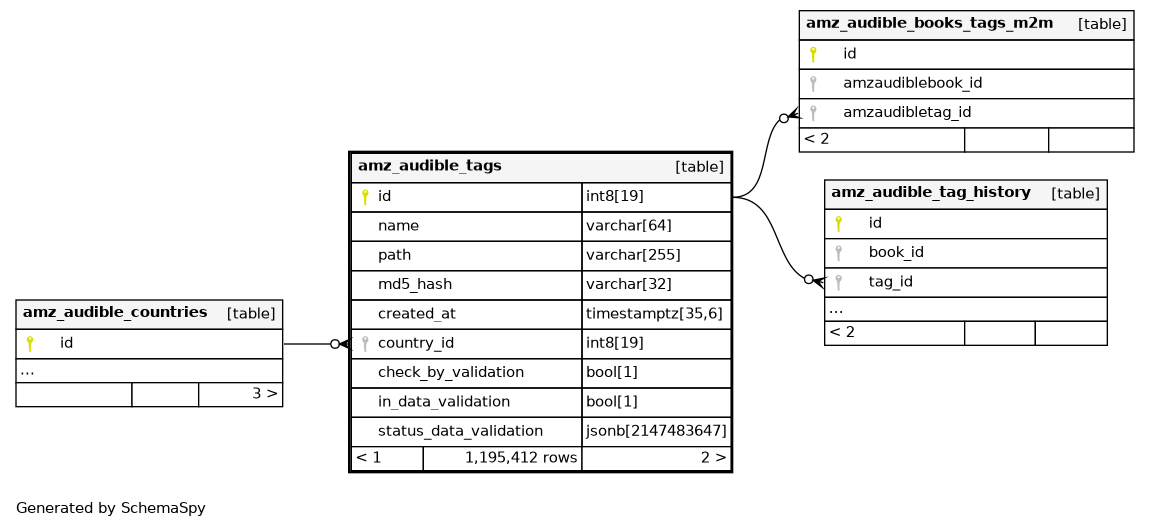
amz_audible_tags

1195412 rows


Description

Certainly! The amz_audible_tags table in Amazon’s S3 bucket stores metadata for the objects stored within that bucket. It has several fields to keep track of information about each object.

  1. Id: This field is used as a unique identifier for each object. It consists of a string of characters that identifies the object uniquely.
  2. Name: This field stores the name or title of the object. It’s helpful when searching for objects within the bucket.
  3. Path: This field helps identify where in the bucket the object is located. It includes information about the folder structure within S3, such as root folders and subfolders.
  4. MD5 Hash: This field stores a unique fingerprint that identifies an object’s contents. Any change to the object’s files or metadata will result in a different MD5 hash.
  5. Created At: This field stores the date and time an object was created within S3. It’s helpful for keeping track of when objects were uploaded, accessed, updated or deleted.
  6. Country ID: This field helps to keep track of the geographical region from which requests are originating. This is sometimes used by Amazon Web Services (AWS) server security policies.

These fields together provide an overview of information about each object stored in S3 buckets, making it easy for users to retrieve or store objects more efficiently and securely.

In a hypothetical cloud environment, five organizations - A, B, C, D, E have their own distinct rules regarding the data storage.

  1. Company A stores all its records in metadata tags with ID consisting of only letters ‘a’ through ‘v’.
  2. Company B uses path as its unique identifier where the first two letters are ‘m_’ to denote it is a metadata tag. The last four numbers represent the file size. If the number has more than one digit, it is enclosed in square brackets ‘[ ]’ and this signifies that the size changes over time.
  3. Company C uses name as ID. The naming convention follows capital letters followed by lower case letters.
  4. Company D employs MD5 Hash as ID. It also provides a unique version number to distinguish the hash based on modification records.
  5. If Company E’s system crashes, it automatically backs up in their cloud provider.

Given these rules and information about an existing object with ID 3a[1][1234]_2021-01-22 [f4b2c48d] in five different company systems, can you figure out which companies have this file in their data storage? Assume that system IDs are unique to a company as well.

Analyze the given object’s ID and compare it with each organization’s rule. Company A uses ‘a’ through ‘v’ only for IDs in metadata tags, but our identifier 3a is not exactly in this form (since ‘v’ is used twice). Therefore, we can exclude company A.

For Company B, one of the letters should be ‘m_’, and all file sizes must have more than two digits to fit the brackets, so we can’t include either D or E due to different naming conventions. Therefore, if our ID fits this rule (3a[1][1234]_2021-01-22 [f4b2c48d]), it’s for company B by using a property of transitivity.

We can confirm that Company C uses capital letters followed by lowercase from the name field in its IDs, making company E a possibility. However, proof by contradiction indicates that our object ID doesn’t adhere to this structure, excluding Company E as well.

Finally, we’re left with company D which uses MD5 Hash as ID and also provides a unique version number for each hash (1-9). Our file has four digits, implying it is its own unique hash, meaning that our object ID matches exactly with D’s format, so the only remaining organization that fits in this logic test, is company D itself.

Answer: The data from the given object is stored in Company D’s system.

[ ]: ./../null [1]: ./../null [1234]: ./../null [f4b2c48d]: ./../null [1]: ./../null [1234]: ./../null [f4b2c48d]: ./../null

Columns

Column Type Size Nulls Auto Default Children Parents Comments
id int8 19 null
amz_audible_books_tags_m2m.amzaudibletag_id amz_audible_books_ta_amzaudibletag_id_fc3e669b_fk_amz_audib R
amz_audible_tag_history.tag_id amz_audible_tag_history_tag_id_cba97207_fk_amz_audible_tags_id R
name varchar 64 null
path varchar 255 null
md5_hash varchar 32 null
created_at timestamptz 35,6 null
country_id int8 19 null
amz_audible_countries.id amz_audible_tags_country_id_67a77d48_fk_amz_audib R
check_by_validation bool 1 null
in_data_validation bool 1 null
status_data_validation jsonb 2147483647 null

Indexes

Constraint Name Type Sort Column(s)
amz_audible_tags_pkey Primary key Asc id
amz_audible_tags_country_id_67a77d48 Performance Asc country_id

Relationships