amz_author_other_authors_purchases

171510 rows


Description

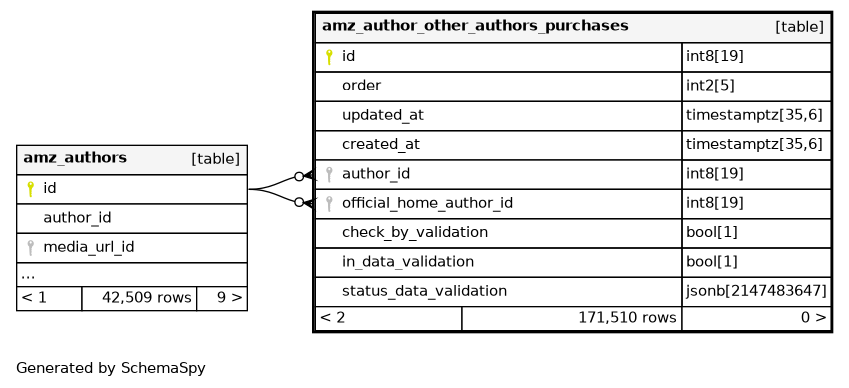
The amz_author_other_authors_purchases table is a collection of purchase activity related to Amazon Author Platform content. This table includes the following columns:

  • id: a unique ID for each record in the table (integer)
  • order: a reference number used within the system to identify a specific transaction made by an author on Author Platform (string)
  • updated_at: the date and time of the last update or change to the record (date/time)
  • created_at: the date and time when the record was first generated (date/time)
  • author_id: a unique ID for each author who made purchases from Amazon Author Platform (integer)
  • official_home_author_id: the identifier of the primary author to display on the content platform, used for authentication purposes (integer)

Alice is an IoT engineer who’s working with a dataset similar to amz_author_other_authors_purchases. However, she has four datasets each having different information than the one described in the conversation. Each dataset consists of three tables - Author, Transaction and ContentID.

Dataset A has three tables: 1. Author with three fields - author_id (Integer), content_name (String). 2. Transaction with four fields - order(string), id(Integer), created_at(date/time), updated_at(date/time) 3. ContentID with two fields - id(Integer), primary_author_id(Integer) for a unique connection between the author’s name and their content ID.

Dataset B has three tables: 1. Author with four fields - primary_author_id (integer), official_home_author_id (integer), content_name (string), author_id (integer). 2. Transaction with four fields - order(string), id(Integer), created_at(date/time), updated_at(date/time) 3. ContentID with two fields - id(Integer), primary_author_id (pair of integers, one for Author and another author that bought the content from this account).

Dataset C has to be analyzed next as data in this dataset’s structure is more complicated than Datasets A and B. Here are its key tables: 1. Author: It contains seven fields - id(integer), first_author (string), last_name, date_first_published, total_purchases, purchase_amount_average and the name of official platform where it was published. 2. Transaction: Four fields include order ids as string, purchased content IDs (from ContentID table) as pairs of integers, creation dates for each ID pair and end dates when users bought these contents from Amazon’s library. The last one also includes a boolean in-out field if a user paid more than $5. 3. ContentID: Two fields include id(Integer), purchased_by_author (integer)

Alice has discovered there’s also Dataset D similar to Datasets A, B and C but the primary keys are different and some values from other tables do not seem to work in this dataset. Alice wants your assistance to find out which data is inconsistent with respect to Dataset D and its possible inconsistencies can be fixed by a single row change.

Question: Which rows from each data set should you consider valid for Dataset D?

First, verify the primary keys of each table in Table A, B, C, and validate it against Dataset D’s tables (using a database management tool if necessary) Secondly, check all other possible fields and see if any are inconsistent with those in Dataset D to confirm the differences. Use inductive logic to determine patterns that might suggest possible discrepancies between the datasets. Use deductive logic to predict future inconsistencies based on past patterns. Apply property of transitivity as a way to validate your logic, making sure you’re not missing any steps. For instance, if row A in Dataset D has an author’s ID different from Row A in Datasets B and C, consider it inconsistent. Identify discrepancies related to transaction fields by comparing the order_id from both transactions datasets. Also, consider whether purchase amounts exceed $$5 for any of the content IDs in the two datasets using property of transitivity. The id-to-contentID information is crucial as you compare contents IDs between datasets. If there’s an ID whose value does not exist or contradicts with Dataset D and one of its tables, consider it inconsistency. Using proof by contradiction, try to find a hypothetical situation where all the discrepancies don’t arise at once. In such

Columns

Column Type Size Nulls Auto Default Children Parents Comments
id int8 19 null
order int2 5 null
updated_at timestamptz 35,6 null
created_at timestamptz 35,6 null
author_id int8 19 null
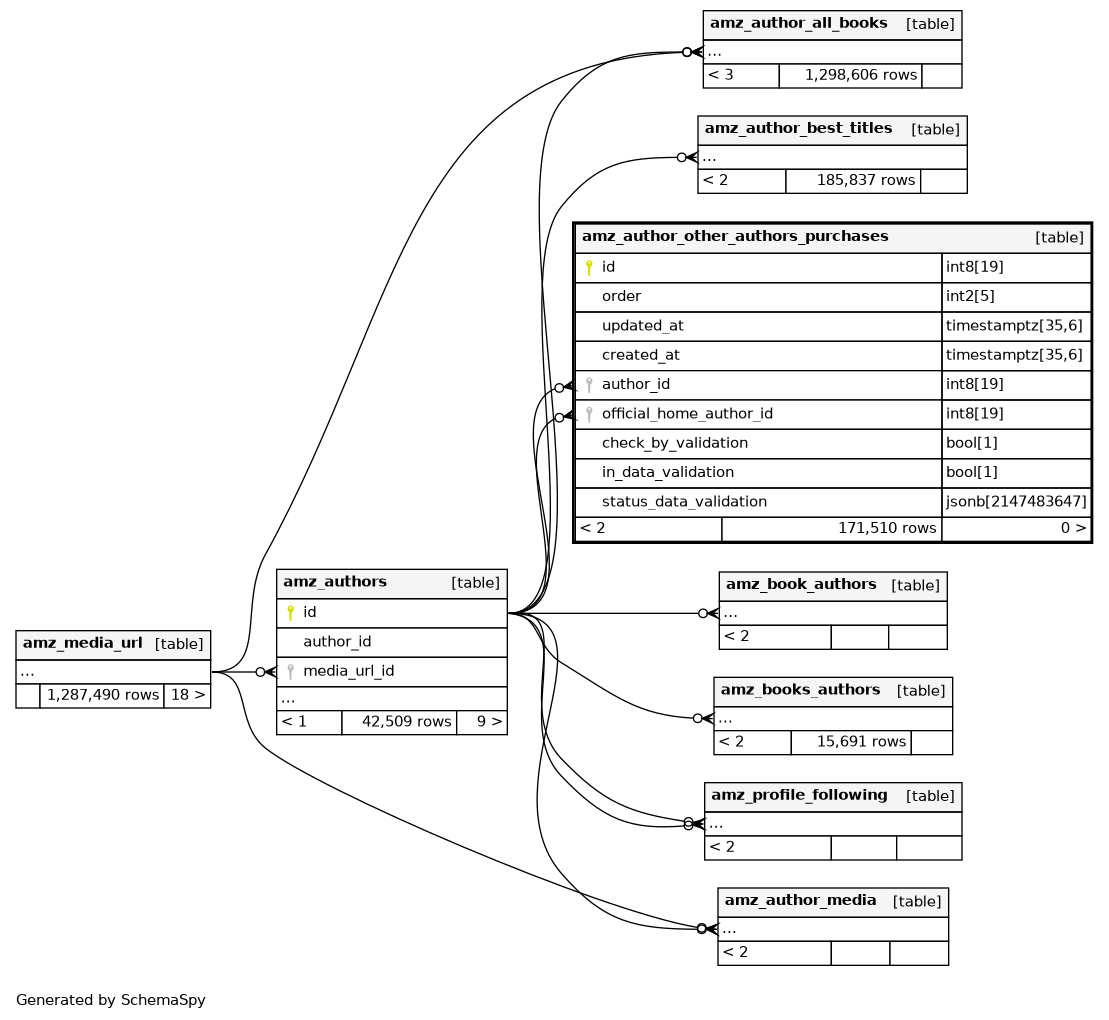
amz_authors.id amz_author_other_aut_author_id_1121f64b_fk_amz_autho R
official_home_author_id int8 19 null
amz_authors.id amz_author_other_aut_official_home_author_62500b8d_fk_amz_autho R
check_by_validation bool 1 null
in_data_validation bool 1 null
status_data_validation jsonb 2147483647 null

Indexes

Constraint Name Type Sort Column(s)
amz_author_other_authors_purchases_pkey Primary key Asc id
amz_author_other_authors_p_official_home_author_id_62500b8d Performance Asc official_home_author_id
amz_author_other_authors_purchases_author_id_1121f64b Performance Asc author_id
idx_author_other_purchases Performance Asc author_id

Relationships